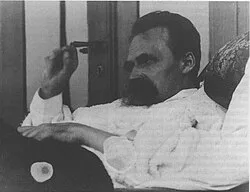
Man is dead! And we have killed him!
A Nietzschean Perspective on Artificial Intelligence
"Shorten this without breaking the meaning," "Give me a summary I can digest at a glance," "Shorter," "Just the main idea," "Trim it down more," "Rewrite my sentences in a professional tone," "Shorter, even shorter," "Don't explain the cause of the bug, just fix it," "SHORTER, AS SHORT AS POSSIBLE!"
Does any of this sound familiar? It certainly does to me. Over the past few years, I’ve realized how heavily I have come to rely on this lazy, shortcut-seeking, results-oriented, and ultimately parasitic mode of communication. A while ago, I noticed I had drastically cut back on taking courses, following training programs, and reading documentation. I lost almost all motivation for them. The mere realization that whenever I needed to learn something, I could manage—partially by learning, or entirely by leveraging AI—deprived me of the very drive to improve myself.
Lately, things have taken an even stranger turn. Knowing there is an entity capable of executing my daily tasks better than I can, no matter how confident I feel in my work, I begin to feel as though I haven't done my best unless I run it past AI. Beyond asking which MacBook is better or which brand of running shoes to buy, I have started having long conversations with it about things that are critically important to me: moral dilemmas, existential angst, personal relationships, political debates...
In 2017, after a group of Google Research researchers, led by Ashish Vaswani, published the paper “Attention Is All You Need,” the foundation for transformer models was laid, marking the first step toward turning transistors into neural cells. We all know what followed through exponential growth: GPT-1, GPT-2, Sonnet, GPT-4.5, Opus, Gemini, Mythos...
At that stage, LLMs had a lot to say but couldn't actually do anything. Then, with the 2022 paper “ReAct: Synergizing Reasoning and Acting in Language Models,” we realized we could translate LLM outputs into concrete action.
To use a slightly uncomfortable metaphor: we placed Stephen Hawking's brain inside Arnold Schwarzenegger, and it worked. Applications are now being engineered specifically for agents to communicate seamlessly, with dedicated protocols being developed for them (MCP).
In light of these advances, it becomes clear that nearly every professional spending most of their time behind a screen is essentially assuming the role of a mid-20th-century telephone switchboard operator. Perhaps in the coming years, computers will become a specialized tool reserved for a select few professions and fade away from everyday life.
Which brings us to the core question: as AI an endlessly capable, limitless source of knowledge now capable of taking action arrives alongside the mechanical revolution knocking at our door (as China's Unitree is currently demonstrating), where does that leave humanity? How will the motivational force that propelled human progress, driving us to constantly evolve and learn, sustain itself when there is already an entity far more capable and knowledgeable than we could ever hope to become?
Across every sector—work, entertainment, healthcare processes are being redesigned around AI. At every step, another layer of human labor becomes obsolete. Because these processes are being structured to be tens or hundreds of times more efficient for both corporations and humanity, neither side seems keen to confront the impending reality. These hyper-efficient years may continue for a while, but eventually, companies and executives will no longer want to retain human resources they deem inefficient. While layoffs may not be fully in the spotlight right now as productivity gains cushion the transition, this will inevitably become a global issue. A concept with such a profound impact on humanity being driven purely by commercial interests by a handful of individuals like Sam Altman, without any meaningful regulation, is the root cause of many of the problems I have outlined. In this process where human existence is being drained of meaning by the insatiable, Erysichthon-like greed of tech giants, we may be witnessing an evolution in reverse. Humanity faces the risk of regressing into beings stripped of the capacity to think, question, learn, and explore.
"The fundamental driving force of man is not merely to survive or to be happier; it is to realize one's own capacity, to grow stronger, to create, and to prove oneself," Nietzsche once noted, capturing that core drive brilliantly.
In The Gay Science, published in 1882, Nietzsche made his declaration in what is perhaps one of his most profound aphorisms, Aphorism 125: "God is dead! And we have killed him." In saying this, Nietzsche was not engaging in an atheist celebration or declaring a victory. On the contrary, it was an awakening, a moment of panic, and a cry against the threat of impending nihilism. For the first time in thousands of years, humanity no longer needed the God/religion hypothesis to make sense of the world. That hypothesis had served its purpose, run its course, and the time had come for man to overcome himself.
So today, has the human being who once overcame himself now killed himself, just as he killed God? Has he reconstructed every quality that gave him worth out of transistors, turning science itself into dogma in his pursuit of absolute truth and perfection?
Nietzsche offered a poignant warning on this very matter: the "will to absolute truth" is merely religious faith in disguise. Science can explain the mechanics of the world to us, but it can never endow it with meaning.