Man Is Dead! And We Have Killed Him
A Look at Artificial Intelligence Through Nietzsche's Window
"Shorten this without losing the meaning," "Give me a summary I can grasp everything from," "Shorter," "Give me the main idea," "Shorten it even more," "Edit my sentences in a professional tone," "Shorter, even shorter," "Don't explain the cause of the bug, just fix it," "SHORTER, AS SHORT AS POSSIBLE!"
Does the above sound familiar to you? It sounds very familiar to me. And over the last few years I've noticed that I've been using this lazy, easy, result oriented, parasitic way of communicating quite a lot. Some time ago I realized I had greatly cut down on following courses, training programs, and reading documentation. I've lost almost all the motivation for it, because knowing I could learn something partly by learning it myself and partly by simply using AI was robbing me of the motivation I needed to improve myself.
These days things have started to feel even stranger. Because I know there's an entity that can do my everyday work better than I can, no matter how confident I am in something I've done, if I don't run it past AI I start to feel like I haven't done my best. Beyond asking which MacBook is better or which brand of sneakers is better, I've started having long conversations with it about everything that truly matters to me. Moral dilemmas, existential struggles, questions about my relationships, political debates...
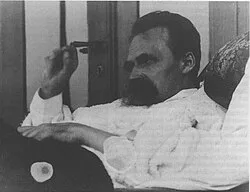
In 1882, in the book he published called The Gay Science, in what may be one of his most profound aphorisms, aphorism 342, Nietzsche declared: "God is dead! And we have killed him." With this Nietzsche was not making an atheistic celebration or a declaration of victory. On the contrary, it holds a realization, a panic, a cry against the approaching danger of nihilism. Because for the first time in thousands of years, man no longer needs the hypothesis of God, of religion, to make sense of the world. This hypothesis has done its job, its time has run out, and now the time has come for man to overcome himself.
So has man, having overcome himself today, also killed himself, just as he killed God? Has he rebuilt everything that made him valuable using transistors, and turned science into dogma while chasing truth in perfection?
Nietzsche offered a fine warning on this: the will to Absolute Truth is, in fact, religious belief in disguise. Science can explain the mechanics of the world to us, but it cannot give it meaning.